
“What Else Is True?” Reflections & Practical Tools for Better Mental Health


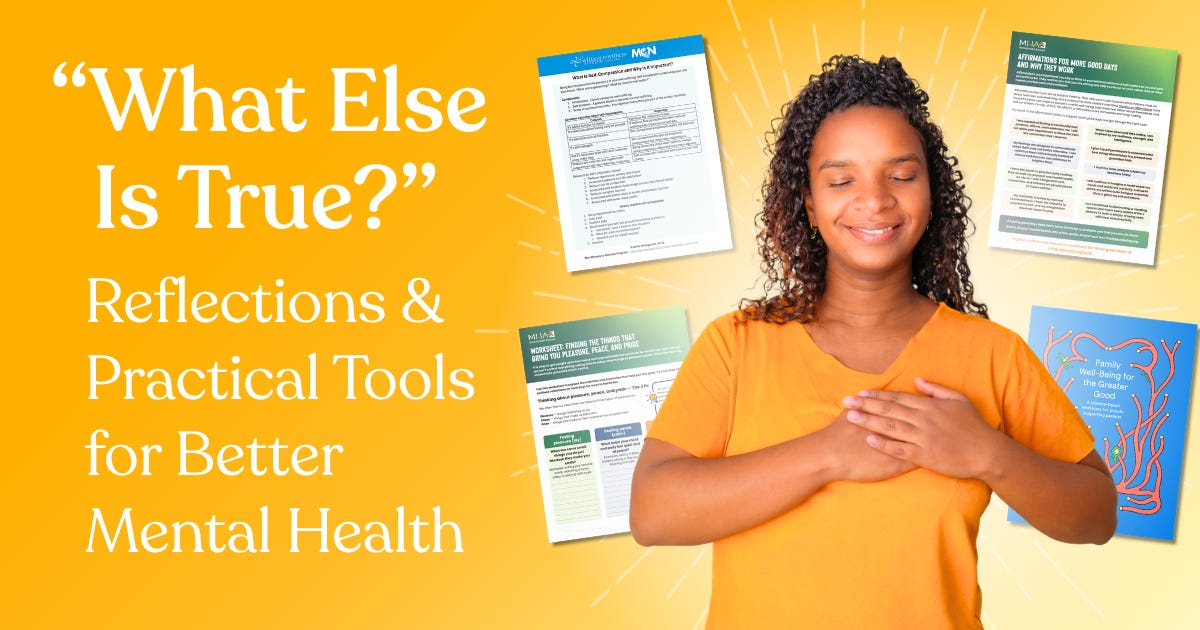
This year’s Mental Health Awareness Month theme by Mental Health America (MHA) is “More Good Days, Together”. It invites us to reflect on what a good day looks like for ourselves and for our communities, and how we can help connect people to the right support at the right time. MHA also reminds us that there is no health without mental health, and that all of us have good days and hard days with our mental health.

For immigrant and migrant families, mixed-status families, and farmworker communities, a good day may mean getting through the day without the constant worry of what could happen on the way to work, school, or a doctor’s appointment. And at the same time, many communities are facing cuts to safety-net programs like Medicaid, mental health provider shortages, limited to no rural mental health services, and community health centers that are being asked to continue to meet the needs of the community with fewer resources.
We often talk about mental health as if it only happens in our thoughts. But stress, fear, and overwhelm are not only in the mind but are physical too. Our hearts may race and our breathing can change. Stomach muscles can tighten and digestion may slow down. When our brain and body sense perceived danger, they shift into survival mode to help us respond and protect ourselves. Our nervous system is connected to almost every major organ in our body. It helps shape how we respond to stress, safety, connection, and threat. And because we all have a nervous system, this is also where our shared humanity begins.

It is quite frequent that health conversations focus only on what is happening inside a person, without paying enough attention to what is happening around them. These reactions can all be normal human responses to difficult or unsafe situations and conditions. A trauma-informed approach helps us meet individuals and communities with more compassion and less shame. In a time when many communities are facing racism, oppression, and limited access to care, the Community Resiliency Model (CRM)® can be especially useful.
CRM was developed by Elaine Miller-Karas and the Trauma Resource Institute as a practical, skills-based approach to help people understand the nervous system and support themselves and others during stress, adversity, and trauma. CRM has been shared with people across cultures, religions, ethnicities, abilities, and identities, including communities impacted by wildfires, floods, earthquakes, war, forced displacement, poverty, and systemic inequities. At the heart of CRM is a simple truth that we all have a nervous system. And healing does not only happen in clinical spaces. Healing can happen in rural communities, disaster recovery spaces, peer support spaces, families, workplaces, and everyday moments of connection.
With all the atrocities we all have witnessed recently, that feels important during this Mental Health Awareness Month. Yes, awareness matters, but awareness alone is not always enough. People also need access to care, dignity, community, and practical tools they can use in real life.

This month, I’m thinking about MHA’s invitation to imagine “more good days, together”, and I’m also asking a CRM informed question: “What else is true?” Fear and uncertainty are real. So are the ways people continue to care for one another. Communities are still protecting each other, community health workers are still showing up with trusted information and connection, and health centers are still opening their doors to their patients. “What else is true?” does not erase what is hard. It helps us make room for the full story and notice what resilience can look like in real life. Even in the middle of stress and uncertainty, there may still be moments of steadiness, connection, and support.
I recently completed the CRM Teacher Training and am now provisionally certified as a CRM Teacher. I was able to participate through a scholarship, and I’m deeply thankful for that opportunity.
Stay tuned for an upcoming webinar where we will share more about CRM and how these wellness skills can be used in community settings. That offering will be part of our upcoming summer series on trauma-informed care. It will be posted shortly at: www.migrantclinician.org/webinars/upcoming. You can subscribe to MCN’s mailing list to receive notifications when webinars are open for registration: www.migrantclinician.org/connect.

Access our Mental Health and Well-Being page to learn more about MCN’s frameworks and access resources for community members in English and Spanish: www.migrantclinician.org/mental-health-and-well-being.

Clinicians have emotional responses to their work that can affect their health and well-being. MCN’s Witness to Witness serves those who are in high stress jobs working with clients who are themselves experiencing high levels of stress. Access numerous resources including a bilingual comic book, archived webinars, and one-page resources on handling workplace issues and managing stress, at www.migrantclinician.org/witness-to-witness.
 | A guest post by
|